
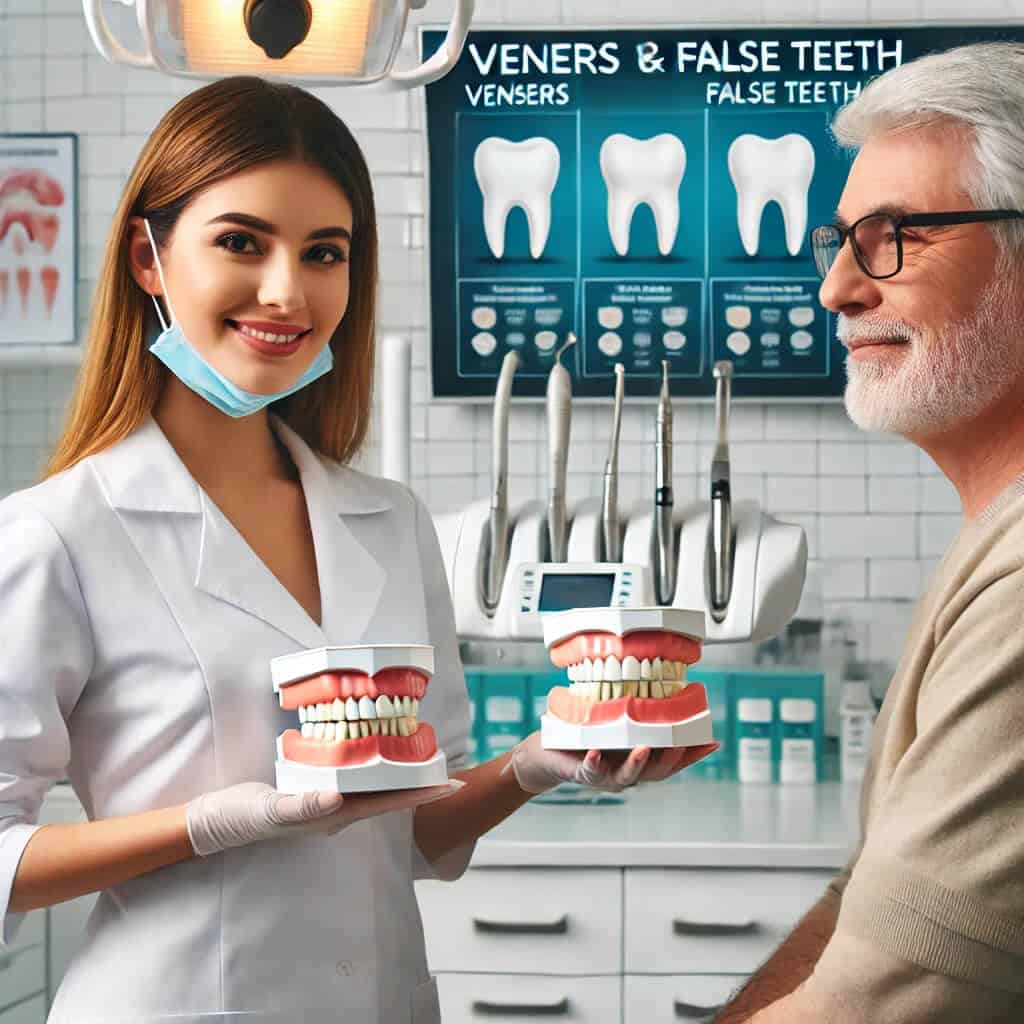
Choosing between veneers and false teeth can be a daunting decision, especially when it comes to improving your smile.
While both options can address dental issues, they serve different purposes and come with distinct benefits and drawbacks.
It can be confusing to determine which option best fits your needs and lifestyle.
This article will clarify the differences between veneers and false teeth, discussing their respective advantages, limitations, and costs.
Table of Contents
What are False Teeth?
False teeth, or dentures, are prosthetic devices designed to replace missing teeth. They can be full or partial, and are made from materials like acrylic, nylon, or metal.
How Do False Teeth Work?
False teeth, also known as dentures, are designed to replace missing teeth and restore functionality. They work by:
- Custom Fit: Dentures are made to fit the unique shape of your mouth, ensuring comfort and stability.
Types of Dentures:
- Full Dentures: Replace all teeth in the upper or lower jaw.
- Partial Dentures: Replace specific missing teeth while preserving remaining natural teeth.
- Attachment Methods: Held in place by suction against the gums, dental adhesives, or metal clasps for partial dentures.
- Functionality: Restore the ability to chew, speak, and improve facial appearance.
- Adjustments: Periodic adjustments are necessary to accommodate changes in the mouth over time, ensuring a proper fit and comfort.
How to Know If you need False Teeth?
You might need false teeth if you experience the following:
- Missing Teeth: Significant gaps or several missing teeth that affect chewing and speaking.
- Difficulty Chewing: Trouble with eating certain foods or discomfort while chewing.
- Tooth Decay or Damage: Extensive decay, fractures, or damage beyond repair of natural teeth.
- Shifting Teeth: Movement of remaining teeth due to gaps or missing teeth.
- Oral Health Issues: Conditions like gum disease that impact the stability of natural teeth.
- Aesthetic Concerns: Desire to improve smile appearance and restore a natural look.
Full check-up, professional cleaning and a full set of X-rays
- Cannot be combined with other coupons or promotions
- Only on full priced items
What is a Veneers?
A veneer is a thin, custom-made shell crafted from porcelain or composite resin. It is bonded to the front surface of a tooth to improve its appearance.
Veneers are used to address issues such as discoloration, chipping, misalignment, and gaps. They provide a natural look and can last 10-15 years with proper care.
How do Veneers Work?
| Step | Description |
| Consultation and Design | The dentist assesses your teeth and designs veneers to match your desired look. |
| Tooth Preparation | A small amount of tooth enamel is removed to ensure a proper fit and natural appearance. |
| Impression and Fabrication | Impressions are taken to create custom veneers, made from porcelain or composite resin. |
| Bonding | Veneers are securely bonded to the front of your teeth using a strong adhesive, enhancing their shape, color, and alignment. |
How to Know if You Need Veneers?
- Discolored Teeth: Veneers can effectively cover stains or discoloration that doesn’t respond to traditional whitening treatments.
- Chipped or Broken Teeth: They are ideal for repairing teeth that are chipped, cracked, or otherwise damaged.
- Gaps Between Teeth: Veneers can close small gaps between teeth, creating a more uniform smile.
- Misalignment: They can improve the appearance of minor alignment issues, providing a straighter look without orthodontics.
- Uneven or Worn Teeth: Veneers can correct teeth that are uneven or have excessive wear, restoring their original shape and function.
Recommended Reading: Dentures vs Veneers vs Implants
What is a Veneers?
A veneer is a thin, custom-made shell of tooth-colored material, usually porcelain or composite resin, designed to cover the front surface of a tooth.
Veneers are used to improve the appearance of teeth by addressing issues such as discoloration, chipped or cracked teeth, and minor alignment problems. They provide a natural look and can last 10-15 years with proper care.
How do Veneers Work?
| Step | Description |
| Consultation | Dentist assesses your teeth and discusses goals for veneer treatment. |
| Preparation | Small amount of enamel is removed from the front of the tooth to make room. |
| Impression | A mold or digital scan of teeth is taken to create the custom veneer. |
| Fabrication | The veneer is crafted in a dental lab based on the impressions. |
| Placement | The veneer is bonded to the tooth with a special adhesive, adjusted for fit. |
Recommended Reading: Dental Implants vs Veneers
How to Know if You Need Veneers?
Veneers are a cosmetic solution for enhancing your smile. You might consider them if:
- Discoloration: Stubborn stains that don’t respond to whitening treatments.
- Chips or Cracks: Minor damage that affects the appearance of your teeth.
- Gaps: Spaces between teeth that you want to close.
- Misalignment: Slight crookedness that doesn’t require braces.
Difference between Veneers and False Teeth
Veneers focus on aesthetic improvements for existing teeth, while false teeth provide a replacement solution for missing teeth.
| Feature | Veneers | False Teeth |
| Purpose | Cosmetic enhancement | Replacement of missing teeth |
| Material | Thin porcelain or composite resin | Acrylic, porcelain, or metal |
| Coverage | Covers only the front surface of teeth | Replaces entire teeth or sets of teeth |
| Application | Bonded to the front of existing teeth | Mounted on a base that fits over gums |
| Durability | Typically lasts 7-15 years | Varies, often 5-10 years |
| Cost | Generally more affordable | Typically more expensive, especially for full sets |
| Procedure | Minimal tooth reduction required | More invasive, especially for full dentures |
Consultation or 2nd opinion
- Cannot be combined with other coupons or promotions
- Only on full priced items
Pros and Cons of Veneers vs False Teeth
| Aspect | Veneers | False Teeth |
| Pros | – Aesthetic Improvement: Enhances the appearance of existing teeth. – Minimal Tooth Reduction: Requires minimal alteration of the natural tooth. – Durability: Typically lasts 7-15 years with proper care. | – Full Replacement: Restores full function for missing teeth. – Customizable: Available in full or partial sets to fit individual needs. – Affordability: Generally less expensive than implants. |
| Cons | – Cost: Can be expensive, with prices ranging significantly. – Durability: May require replacement or repair if damaged. – Not Suitable for All Issues: Only addresses cosmetic issues, not structural problems. | – Comfort and Fit: May require adjustments and can be less comfortable than natural teeth. – Maintenance: Requires regular cleaning and possible relining. – Aesthetic Limitations: May not look as natural as veneers or implants. |
Average Price of False Teeth in Kendall Miami
The average price of false teeth (dentures) in Kendall, Miami, typically ranges from $1,000 to $3,000 per set. The cost can vary based on factors such as the type of dentures (full or partial), the materials used, and the complexity of the fitting process.
Average Price of Veneers in Kendall Miami
The average price of veneers in Kendall, Miami, ranges from $1,000 to $2,500 per veneer. The cost can vary depending on factors such as the type of veneer (porcelain or composite), the complexity of the procedure.
Recommended Reading: Veneers vs. Dentures: Comparing Costs in Miami
Key Takeaways: Veneers vs False Teeth
- Purpose and Use: Veneers are thin, custom-made shells bonded to the front of teeth to improve appearance, while false teeth (dentures) are removable appliances used to replace missing teeth.
- Material: Veneers are typically made from porcelain or composite resin, providing a natural look. False teeth are generally made from acrylic or metal.
- Durability and Longevity: Veneers last 7-15 years with proper care, while false teeth may need replacing or adjustment more frequently.
- Cost: Veneers are often more expensive upfront compared to false teeth but offer a more permanent solution.
In Artistic Smiles Miami Dentist, we’re experts in Dental Implants in Miami with +25 years of experience, contact us to get a free consultation.
Conclusion: Veneers vs False Teeth
They are a great option for those looking to correct cosmetic issues like discoloration or misalignment.
On the other hand, false teeth are a practical solution for replacing missing teeth, offering functionality and restoration of full oral function.
While veneers tend to be a higher initial investment, they offer a durable, aesthetically pleasing result. False teeth provide a cost-effective alternative with regular adjustments needed.